
Most Contractors Aren’t Ready for a $4.5 Million Contract. Here’s Why.
It has nothing to do with your capability. It has everything to do with your systems.
7 min read
TL;DR
A $4.5M contract will expose every gap in your business. Payroll, hiring, project tracking, communication, all of it.
AI won’t save you if you don’t have systems underneath it
I learned this the hard way running a cleaning service before I ever touched GovCon
The progression that works: manual first, then automate, then add AI
If you can’t run your current contracts without chaos, you’re not ready to scale
FLOW and RUN are the difference between winning a contract and surviving one
Everyone Wants AI. Nobody Wants to Build the System First.
I’m going to say something that might upset the AI crowd.
AI is not a system. It’s a tool.
And right now, I’m watching new GovCon contractors rush to plug ChatGPT into their proposal process, automate their capability statements, and use AI to “do everything.” Meanwhile, they can’t tell me how they track their subcontractor hours. Or how they onboard a new hire. Or what happens when a CO asks for a status update and nobody knows where the deliverables stand.
Here’s the truth: AI can only do what it’s instructed to do. If you don’t have clear processes, defined roles, and operational systems running your business, you’re giving AI garbage instructions and expecting gold output. I wrote about this same problem in AI Proposal Writing Software Won’t Save You. The tool isn’t the problem. The missing system is.
You wouldn’t hand a new employee a laptop and say, “figure it out.” But that’s what most contractors are doing with AI.
A $4.5 Million Contract Will Break You Without Systems
Let me paint the picture.
You win a $4.5M contract. Congratulations. Now what?
Within 30 days, you need to:
Hire 8-12 qualified people. Where’s your hiring pipeline?
Set up payroll and benefits for a distributed team. Who’s running that?
Track 15+ deliverables across multiple task orders. In what system?
Report burn rates to the CO every month. Do you even know your burn rate right now?
Manage subcontractor performance and invoicing. How are you tracking that?
Communicate status updates across your team, the CO, and the client. Where does that live?
If you don’t have systems for each of those things before you win, you’ll spend the first 90 days in pure chaos. In GovCon, 90 days of chaos on a $4.5M contract can tank your past performance rating, trigger a cure notice, or get the contract terminated for cause. That means you lose the contract, damage your reputation, and make it harder to win the next one.
I’ve watched it happen to 3 contractors in the last 2 years.
That’s your RUN system. Roles, Updates, Numbers. Who owns what. How you communicate. Where the money stands. Without RUN, you don’t survive the contract you won. If you want to know what COs are watching for when things start to slip, read What Contracting Officers Actually Look For.
I Learned This Scrubbing Floors, Not Writing Proposals
Before GovCon, I built a cleaning service from scratch.
No employees. No clients. Me, a mop, and a plan.
That business grew to over 6 figures. And along the way, I learned every lesson that now powers my GovCon business. The only difference? Toilet brushes instead of task orders.
When I had 3 employees, I could keep everything in my head. When I had 12, I couldn’t. I needed a system for scheduling. A system for quality checks. A system for client communication. A system for payroll. A system for hiring and firing.
I built every one of those systems manually first. Spreadsheets. Checklists. Written SOPs. I knew how each process worked because I had done it by hand hundreds of times.
Then I automated. Scheduling software. Payroll systems. Client portals.
Then, and only then, could I add AI tools to enhance what already worked.
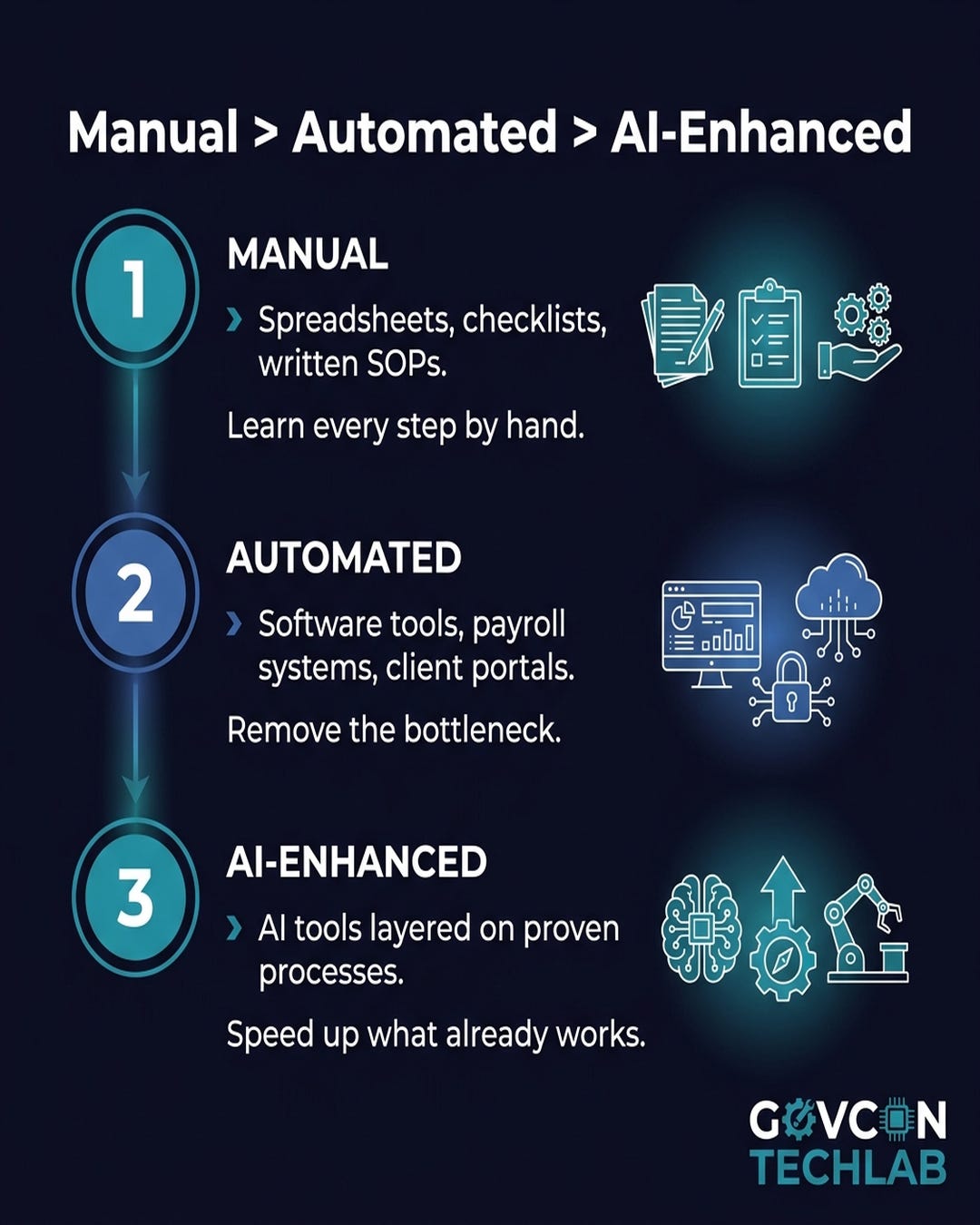
That’s the progression most contractors skip: manual, then automated, then AI-enhanced.
They want to jump straight to AI-enhanced without ever understanding the manual process. And it shows.
Your FLOW Is Broken and You Don’t Even Know It
FLOW is how your business operates day to day. Funnel, Leverage, Operations, Wins.
Here’s a quick diagnostic. Answer honestly:
Funnel: Can you tell me right now how many opportunities are in your pipeline and their expected award dates? Or are they scattered across SAM.gov bookmarks, email threads, and sticky notes?
Leverage: Are you using tools and people to multiply your capacity? Or are you the bottleneck for every decision, every email, every deliverable? If that sounds familiar, The “I Can Do the Work” Trap is worth reading next.
Operations: If you were unavailable for 30 days, could your business deliver on its current contracts without you? Or does everything stop?
Wins: Do you track what’s working? Win rates? Proposal scores? Client feedback? Or do you move to the next bid and hope?
If you couldn’t answer at least 3 of those with confidence, your FLOW is broken. No AI tool is going to fix that.
AI can optimize a pipeline you’ve already built. It can’t build the pipeline for you. Not the real one. The one with human judgment, relationship tracking, and strategic decisions baked in.
The 5 Systems Every GovCon Business Needs Before They Touch AI
Here’s what I tell every contractor I work with. Get these running manually first. Then automate. Then enhance.
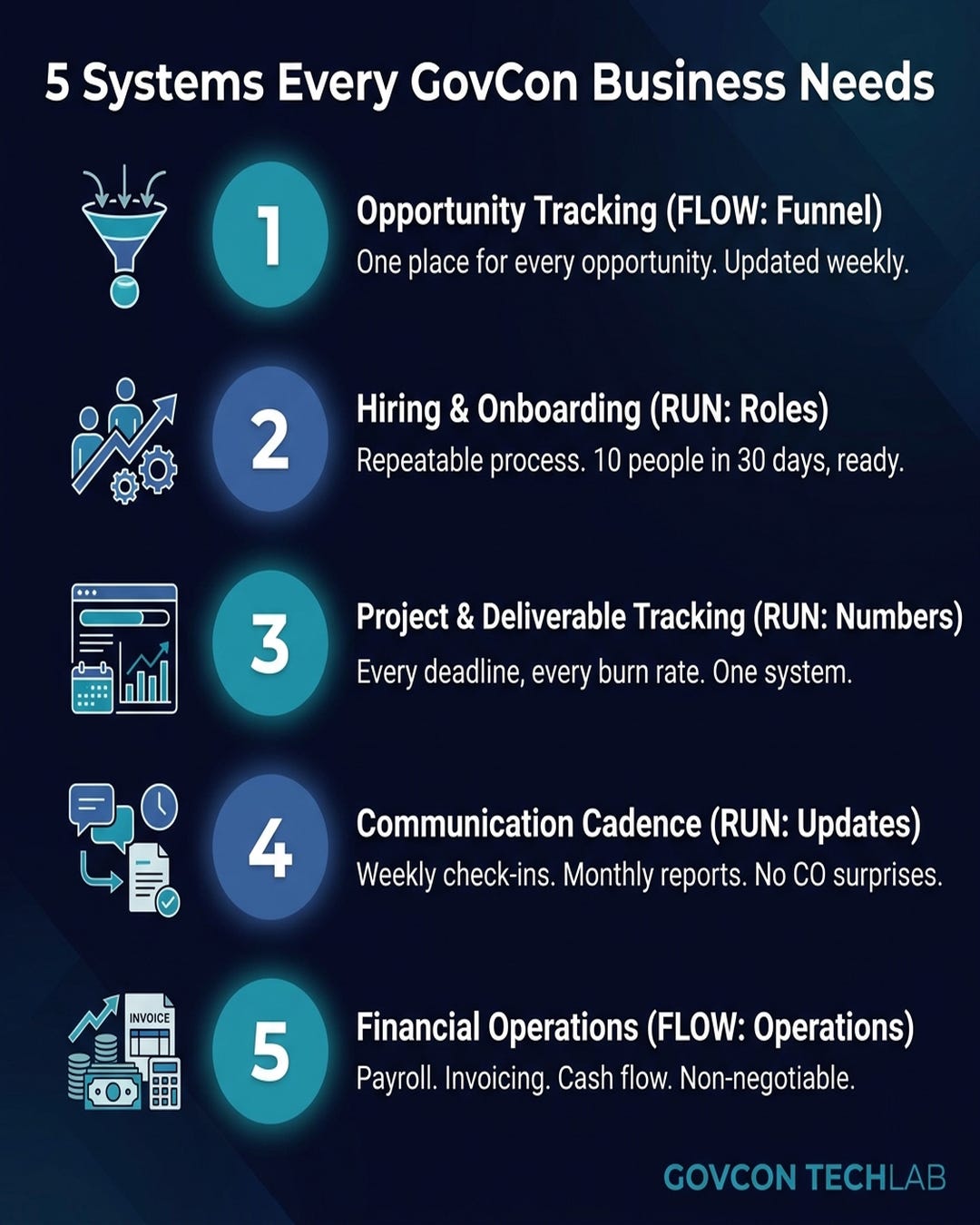
1. Opportunity Tracking (FLOW: Funnel)
One place where every opportunity lives. Status, due dates, contacts, notes. I don’t care if it’s Notion, a spreadsheet, or a whiteboard. It has to exist and you have to update it weekly. Without it, you’re chasing random bids instead of building a strategic pipeline.
2. Hiring and Onboarding (RUN: Roles)
A repeatable process for finding, vetting, and onboarding talent. When you win a contract that needs 10 people in 30 days, “I’ll figure it out” is not a plan. It’s a panic attack waiting to happen.
3. Project and Deliverable Tracking (RUN: Numbers)
Every contract, every task order, every deliverable, every deadline. Tracked in one system. With burn rates. Updated weekly. Non-negotiable. One missed deliverable on a federal contract can trigger a corrective action. Need help understanding what to track? How to Price Your Government Contract breaks down the numbers side.
4. Communication Cadence (RUN: Updates)
How often do you talk to your CO? Your team? Your subs? Set the rhythm. Weekly check-ins. Monthly reports. Quarterly reviews. Write it down. Follow it. Your CO should never have to chase you for a status update.
5. Financial Operations (FLOW: Operations)
Payroll. Invoicing. Burn rates. Cash flow projections. If you’re running a $4.5M contract and you’re still doing this in your head or a single spreadsheet, you’re one bad month away from a serious problem.
What to Do Right Now
You don’t need to build all 5 systems this week. But you need to start.
Pick the one that’s most broken. The system where you lose the most time, drop the most balls, or feel the most stress. That’s your starting point. (15 minutes to decide.)
Document the current process by hand. Write down every step, every handoff, every decision point. Don’t skip this. If you can’t write it down, you don’t have a process. You have a habit. (1-2 hours.)
Run it manually for 2 weeks. Follow your written process. Track where it breaks. Fix the gaps. This is where the real learning happens.
Then automate. Move it into a tool. Notion, Monday, Asana, whatever fits. The tool doesn’t matter. The process underneath it does.
Then consider AI. Use AI to speed up what’s already working. Not to replace what you never built.
The Bottom Line
I didn’t start with $400K in annual federal revenue and a system for everything. I started with a cleaning service, a mop, and the willingness to build processes by hand until they worked.
After 7 years as an active contractor, every system I run today started as a manual process. Then I automated it. Now AI enhances it.
That’s the order. Manual. Automated. AI-enhanced.
If you skip steps 1 and 2, step 3 is expensive chaos with better branding.
Most contractors aren’t ready for a $4.5M contract. Not because they can’t do the work. Because they don’t have the systems to manage the work.
Build the systems. The contracts will follow.
P.S. Not sure where to start? Take the free Pathway Assessment Quiz. It tells you exactly which part of your GovCon business needs systems first: https://quiz.govcontechlab.com
Chat soon,
Steph