AI Proposal Writing Software Won't Write Your Way to a Contract. Here's What It Actually Does.
The contractors using AI to skip the hard work aren't winning more. They're losing faster.

Read time: 6 minutes
TL;DR
AI proposal tools are everywhere. Most of them are ChatGPT with a GovCon logo slapped on top.
I reviewed a teaming partner’s AI-generated technical approach. It was grammatically perfect and completely empty.
If you’ve never seen a winning proposal from the inside, you can’t tell the difference between a polished paragraph and a competitive one. That’s the real danger.
AI makes good GovCon operators faster. It makes bad ones look more professional while they lose.
Where AI actually helps: RFP digestion, compliance checklists, outline scaffolding, editing. Not writing your entire technical approach from scratch.
Bottom line: Capture first. Strategy second. AI last. In that order. Every time.
I opened a teaming partner’s draft and knew immediately what had happened.
They had real technical expertise. Strong past performance. On paper, exactly the kind of partner you want on a competitive bid.
Their technical approach section? It rewrote the SOW back to the evaluator in slightly different words and said, in about 12 different ways: we can do this.
No approach. No structure. No metrics. No past performance woven into the narrative. No evidence they understood the customer’s actual pain points.
It looked complete. It was empty.
We had to rebuild that section from scratch — pull in real performance data, tie their capabilities to the agency’s specific environment, add proof points, align every claim with the evaluation criteria — under deadline.
The AI didn’t save us time. It gave us bland text we then had to rescue.
The Fantasy vs. What Actually Wins
There’s a pitch floating around GovCon right now
Download the AI proposal tool
Upload the RFP
Click “Generate”
Win the contract
I’m not going to be polite about this: that’s not innovation. That’s a faster way to lose.
Winning a government contract requires capture. It requires understanding who the buyer is, what they’re scared of, who they’re currently using, and why they’d take a risk on you. It requires a story, one that connects your specific past performance to this agency’s specific problem.
AI has never sat in a pre-solicitation meeting. It has never read the room with a contracting officer. It has no idea what the agency actually cares about vs. what they wrote in the SOW.
When you skip capture and ask AI to “just write the proposal,” you’re not working smarter. You’re abdicating the one job that determines whether you win or lose.
The Gap Nobody Talks About
Here’s is what the AI proposal tool vendors won’t say out loud:
You have to already know what a winning proposal looks like to know if AI is producing one.
Experienced contractors — people who’ve sat through debriefs, survived recompetes, heard evaluators explain exactly why a proposal scored a 3 instead of a 5 — have an internal compass. They can open an AI-generated draft and immediately see what’s missing.
Where’s the evidence? Where are the metrics? Does this actually answer Section L? Does this align with our win themes or is it just... words?
They use AI as a starting point and fix what’s broken. They’re in control.
New contractors don’t have that compass yet. When an AI tool produces something that looks polished and professional, they think: this must be good. They have no way to evaluate whether it’s compliant, whether it’s believable, whether it differentiates them from the other 12 offerors on that solicitation.
They’re judging the proposal by grammar. Evaluators are judging it by a scoring matrix. That’s a dangerous gap. And no AI tool closes it for you.
What the Community Is Actually Saying
I posted about this on LinkedIn. The response confirmed I’m not alone.
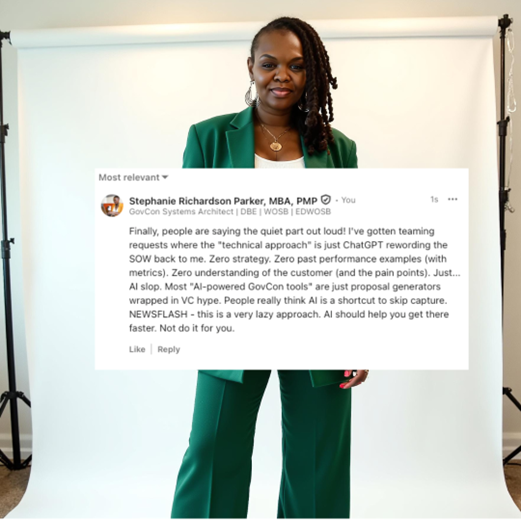
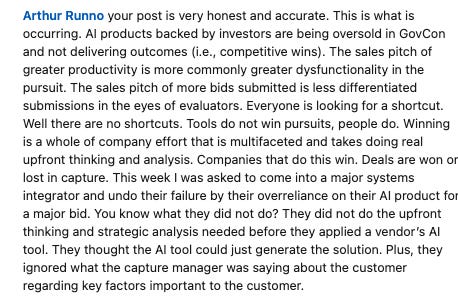
**this was a post from another contributor
Experienced practitioners are watching the same pattern play out. Teaming requests showing up where the “technical approach” is the SOW reworded by ChatGPT. Zero strategy. Zero past performance with metrics. Zero evidence the team understands the customer.
On Reddit’s GovCon communities, the pushback from people with real scar tissue is sharp: most of these tools are “80% marketing and 20% value.” Wrappers and filters dressed up as innovation.
The people who actually understand how proposals get evaluated are saying the same thing: AI is a copilot. Not an autopilot.
The ones buying the fantasy? They’re the ones submitting 20 proposals a year and winning nothing.
Where AI Actually Earns Its Place
I use AI in my own proposals. I’m not anti-AI. I’m anti-skip-the-hard-work. Here’s where it actually works:
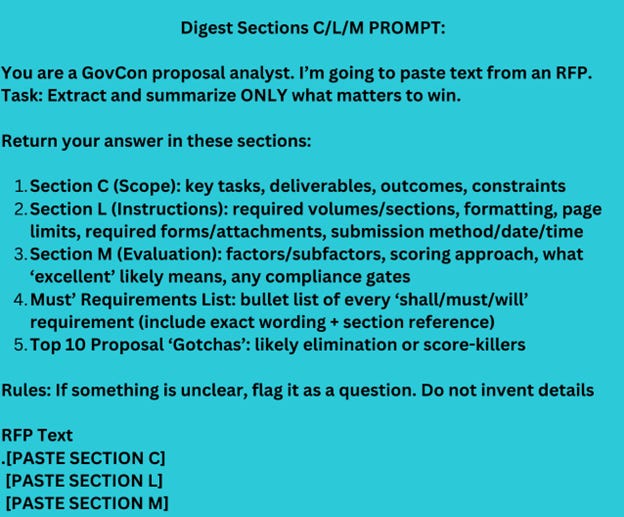
RFP digestion. Paste Sections C, L, and M. Ask AI to summarize key requirements, deliverables, and evaluation factors in plain language. Brief your team in 20 minutes instead of 3 hours.
Here’s the prompt:
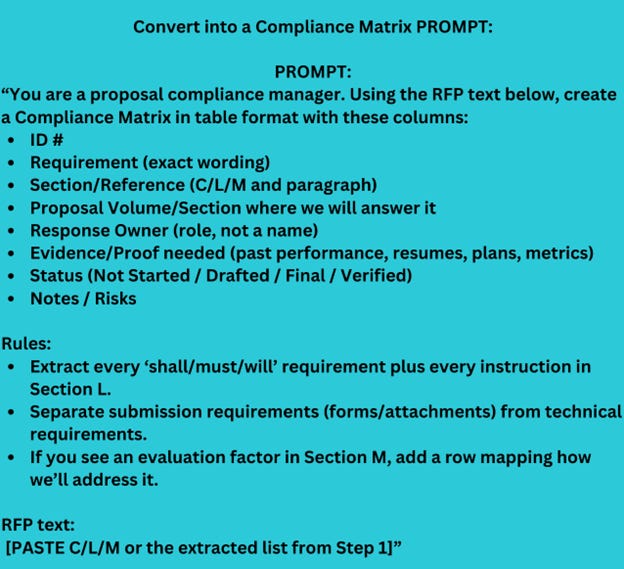
Compliance checklists. Turn the RFP instructions into a structured matrix. Use AI to help track “Did we address this?” before it gets to red team review.
Here’s the prompt:
Win themes. Feed AI your meeting notes and market research. Ask it to pull out themes and pain points that belong in your win themes.
Here’s the prompt:
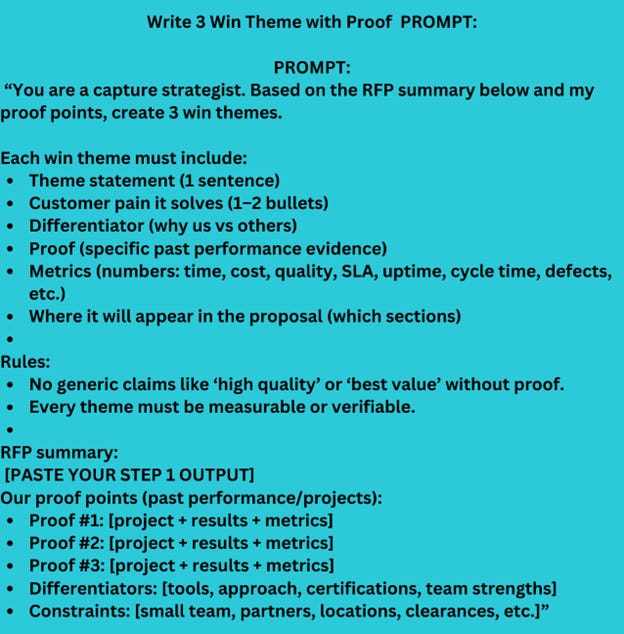
Editing and clarity. Use AI to tighten language and improve readability — after you’ve done the thinking and built the argument.
Here’s the prompt:
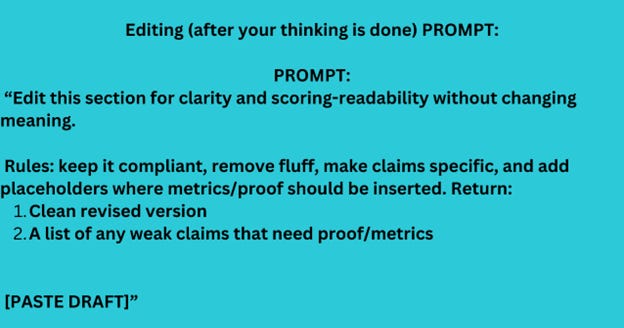
Notice what every single one of those has in common: AI is supporting your system. It is not replacing it.
The Right Order (And Why Most People Get It Backwards)
The contractors losing with AI are following this sequence:
Skip capture → Skip strategy → Buy AI tool → Generate proposal → Lose → Repeat The contractors winning with AI are following this one:
Step 1 — Capture. Who is the buyer? What do they actually care about? Who are they using now? What’s the real problem behind the requirement?
Step 2 — Positioning. Why you? What’s your angle? What do you bring that is lower risk, more credible, and more specific than the other offers?
Step 3 — System. How do you consistently move from opportunity to decision to capture to outline to draft to submission?
Step 4 — Tools. What can AI do to make each stage of that system faster?
If you don’t have steps 1 through 3, AI just helps you produce more noise. Faster.
What Evaluators Actually Care About
Contracting officers do not care whether you used AI (this may change), Microsoft Word, or a legal pad.
They care that your proposal follows the instructions, addresses the evaluation criteria, demonstrates real understanding of their mission, offers a clear and believable solution, and aligns with past performance they can actually verify.
AI cannot guarantee any of that on its own. You still have to decide which past performance examples fit this specific story. You still have to craft win themes that speak to this agency’s specific concerns. You still have to own every promise you put on paper.
If your proposal reads like a generic AI-generated document, it tells the evaluator exactly one thing: you didn’t bother to understand them.
The Bottom Line
Tools are cheap. Templates are everywhere. New “AI proposal writers” will keep launching every month.
What stays rare and valuable is this: contractors who understand how the government actually buys, who respect the capture process, and who can use AI to go faster without getting lazy.
Stop asking: “How can I get AI to write this for me?”
Start asking: “How can I build a GovCon system that AI can support — but never replace?”
That’s the difference between contractors who use AI to win more and contractors who use AI to lose more efficiently.
If you found this useful, subscribe to GovCon TechLab. Every week: real tools, real data, and no guru BS — from an active contractor who’s still in the trenches.
Chat soon,
Steph
P.S. — Next issue, I’m breaking down the exact prompts I use to digest a 200-page RFP in under 30 minutes. Subscribe so you don’t miss it.