
You Got Ghosted by a Contracting Officer. Here's Why, and What to Do Instead.
The real reasons COs go silent and the three approaches that actually get responses.

Read time: 8 minutes
TL;DR
Contracting officer ghosting is systematic, not personal, reduced staff means COs handle 2-3x normal workload
COs are personally liable for contractor selection and legally restricted on when they can communicate
Cold outreach fails because COs only respond on a must-needed basis to contractors they don’t know
Three approaches that work: subcontractor introductions, industry days, and agency small business liaisons
Successful contractors build relationships before they need them, not after seeing an RFP
You’ve been emailing that contracting officer for three weeks. You submitted a solid proposal. You know you can do the work. Radio silence.
“You will get ghosted into oblivion.” That’s not me being dramatic, that’s a direct quote from a govcon Reddit thread with 400 upvotes. And it captures exactly what Marcus, the IT project manager with a 2-year-old LLC, experiences every time he tries to connect with an agency.
I’m working with a client right now on a FEMA project. The work has been awarded. We’re trying to reach the contracting officer about funding details. We’ve been working with this CO for years. It’s still like pulling teeth.
That tells you everything you need to know about the current state of CO communication. If contractors with established relationships struggle to get responses, imagine what it’s like for someone trying to break in.
What’s Actually Happening When COs Go Silent
Here’s what nobody tells you: it’s not personal. It’s not your proposal. It’s not your qualifications. It’s the system.
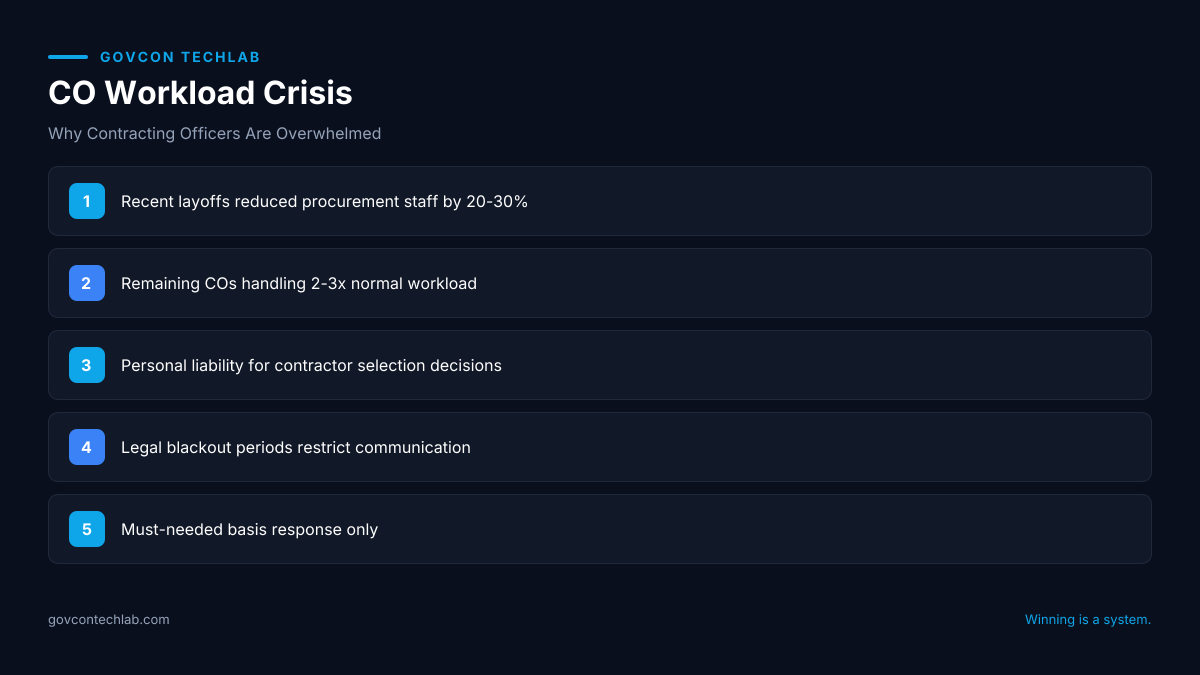
A lot of contracting officers have recently lost their jobs. Budget cuts, reorganizations, early retirements, the procurement workforce has shrunk while the contract volume stayed the same. The remaining COs are handling 2-3x their normal workload.
They’re only responding on a must-needed basis.
And here’s the part that really stings: they’re being held personally liable for the contractors they choose. A bad contractor decision can cost them their career. So, they’re taking their time, especially with contractors they don’t know.
There are also legal restrictions around when they can even talk to you. Before award, during blackout periods, after protest deadlines, there are windows when they literally cannot respond, even if they want to.
So, when you submit that proposal and hear nothing? When your follow-up emails disappear into the void? It’s not a reflection of your capability. It’s a reflection of a system under stress.
If you want a head start on understanding how to navigate this system, grab the free GovCon Clarity Kit at https://claritykit.govcontechlab.com, it includes the agency relationship framework I use with clients.
The Three Approaches That Actually Work
When cold outreach fails, and it will fail most of the time, here are the three strategies that consistently break through:
1. The Subcontractor Introduction
Instead of going direct to the CO, get introduced through the prime contractor. If there’s a prime on the contract you’re targeting, reach out to them about subcontracting opportunities.
But this needs to be done correctly, or this can bite you in the butt. You have to first develop a relationship with a prime. If you are working with a prime on a contract, DO NOT go around them to introduce yourself to the CO in an effort to pitch your products and services. This is inappropriate. If the prime has relationships with multiple CO’s (that they are not working with at the time), it’s ok to ask the prime for an introduction. The most important thing here, is that you don’t go around the prime and compete with them on a project that you are subcontracting with them.
This works because:
- The prime has direct access to the CO
- They have business reasons to make introductions (they need good subs)
- The CO trusts the prime’s judgment
- It’s a warm introduction with business context
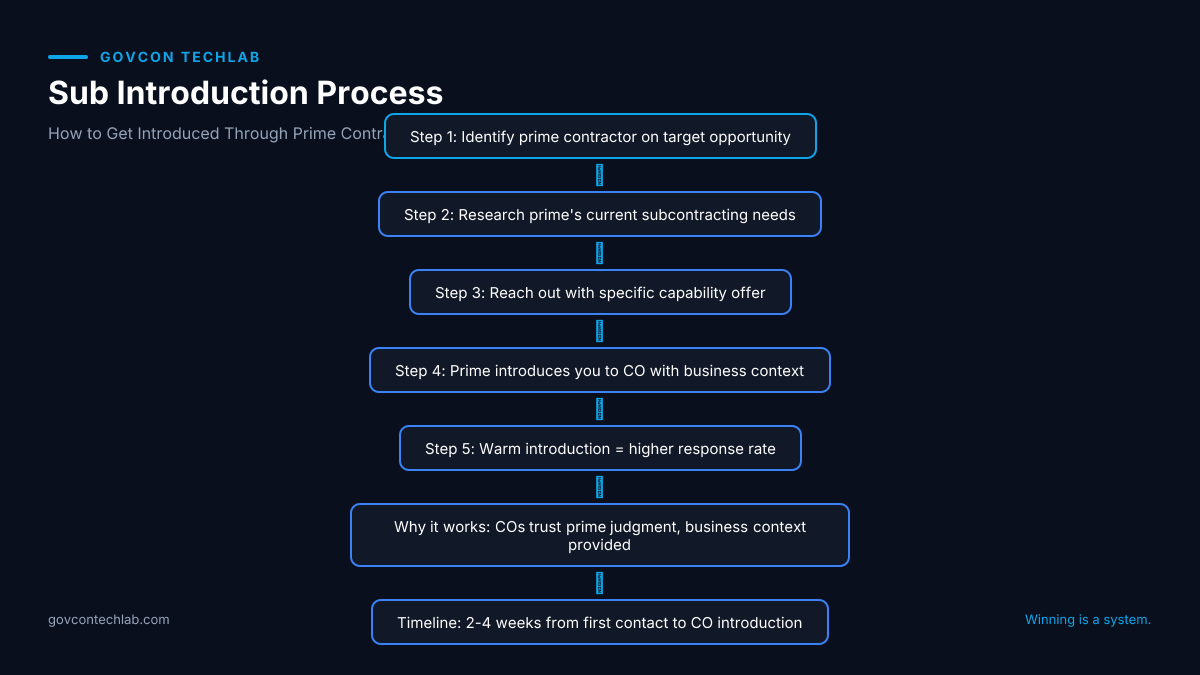
Find the prime by looking at past awards in USASpending.gov or checking the contract history on the agency’s website. Then approach them with a specific capability they need, not a general “we can help” message.
2. The Industry Day Strategy
Most agencies hold industry days, vendor forums, or one-on-one meetings before big procurements. This is where COs are required to talk to you. It’s structured. It’s official. It’s on their calendar.
Check the agency’s acquisition forecast. Look for “Sources Sought” notices on SAM.gov, these often include industry day announcements. Register early because these meetings fill up fast.
The key is showing up prepared. Don’t use industry days for general introductions. Come with specific questions about the upcoming procurement and specific opportunities and clear value propositions for your capability.
3. The Legislative Affairs Angle
Every agency has an Office of Small and Disadvantaged Business Utilization (OSDBU). They’re measured on small business participation. They have direct access to COs and a mandate to help you connect.
I want to be honest about this strategy. At the time that this article is being published, a lot of OSDBU offices have been closed. Many small business specialists have been laid off and the specialists remaining may be overworked. However, I do know colleagues who have connected with some great small business specialists and have had success getting introductions to CO’s and Program Managers.
Call the main agency number and ask to be transferred to the OSDBU office. Explain what you’re trying to do. They’ll either connect you directly or tell you the exact process for that agency.
What Doesn’t Work (So You Can Stop Wasting Time)
Persistence without strategy. Sending the same follow-up email every week just makes you look desperate.
Calling the main agency number and asking to be transferred to “procurement.” You’ll get bounced around or transferred to someone who can’t help you.
Showing up at the agency unannounced. Security won’t let you past the lobby, and even if they did, you’d be interrupting someone who doesn’t have time for unscheduled meetings.
And here’s the hard truth: if you submitted a proposal and you’re getting ghosted during the evaluation period, they’re probably moving forward with someone else. The sales cycle is longer now, but radio silence usually means you’re not in the running.
The Real Pattern Behind Consistent Winners
I covered this in more detail in By the Time the RFP Drops, You’ve Already Lost, the contractors who consistently get responses have one thing in common: they have established relationships before they need them.
They’re not cold-outreaching after they see an RFP. They’ve been building relationships for months through the three channels above.
They show up at industry days. They partner with primes on proposals. They know the small business liaisons at their target agencies. When an opportunity drops, they’re not starting from zero.
Your Next Action
Pick one agency you want to target. Find their next industry day or vendor forum. Register. Show up. Start building the relationship now, not when you need something.
The goal isn’t to pitch your services. The goal is to become a known quantity so that when you do need to reach a CO, you’re not just another random email in an overflowing inbox.
That’s how you break through when everyone else gets ghosted. For more tactical guidance on building these relationships, check out govcontechlab.com.
Ready to stop getting ghosted and start building real agency relationships? Start with the free GovCon Clarity Kit at https://claritykit.govcontechlab.com.
Chat soon,
Steph