I Wrote 23 Proposals From Scratch. Then I Built This Workflow.
Why your proposal problem isn't writing—it's systems (and how to fix it in 45 minutes)

Read time: 6 minutes
TL;DR
The real problem: You’re starting every proposal from scratch—new RFP = new panic = 40-hour sprint
The fix: 5-part workflow that turns proposals into assembly, not creation
Time saved: 40 hours → 18 hours per proposal (22 hours back per bid)
Win rate impact: Went from 0 of 23 wins to 4 of 12 (33% win rate)
What to do today: Build your compliance matrix + reusable sections (45 minutes total)
Bottom line: Stop reinventing. Start assembling.
I Lost Because I Kept Starting Over
Proposal #23.
11 PM on a Thursday. I’d spent 38 hours on a Department of Transportation RFP for IT support services. Hit submit at 11:47 PM.
Two weeks later: “Thank you for your interest, but...”
I opened the folder where I’d saved the proposal.
Company overview—written from scratch. Management approach—written from scratch. Quality control section—written from scratch.
All of it was work I’d done before. On Proposal #11. And Proposal #17.
I wasn’t losing because I couldn’t write.
I was losing because I was treating every RFP like a brand-new event.
The Real Problem (It’s Not What You Think)
Most contractors think their proposal problem is one of these:
“I’m not a good writer”
“I don’t have enough past performance”
“I need better win themes”
Wrong.
The real problem is this:
Every RFP feels like starting from zero.
New folder. New outline. New panic. New 40-hour death march.
That’s not a skill issue. That’s a systems failure.
Here’s what changed everything for me.
The Rule That Fixed Everything
I operate by one rule now:
You should never be “starting” a proposal. You should only be assembling one.
That one shift changed:
How I work (systematic, not chaotic)
How fast I move (18 hours, not 40)
How burned out I feel (manageable, not destroyed)
Let me show you the workflow.
The 5-Part Proposal Workflow
This is what I use now. Every time. No exceptions.
Part 1: Intake (Before You Write Anything)
Goal: Understand the opportunity, don’t just react to it.
Time: 10-15 minutes
Here’s what this looks like in practice:
RFP: IT Support Services, $250K, 3-year base + 2 option years
My intake notes:
Scope: Help desk + network monitoring for 200 users at 3 locations
Contract type: Firm Fixed Price (monthly)
Evaluation: 60% technical, 30% past performance, 10% price
Compliance: FISMA certified staff
Due date: February 15 (21 days out)
Set-aside: Small business
Decision: GO. Matches our capabilities, realistic timeline, we have relevant past performance.
I extract this BEFORE I open a Word doc.
If I skip this step, I end up 30 hours deep before I realize I’m missing a critical requirement.
Part 2: Compliance First (Always)
Goal: Build the skeleton before you write the body.
Time: 20-30 minutes
Before I write a single narrative paragraph, I build a compliance matrix.
Here’s the format:
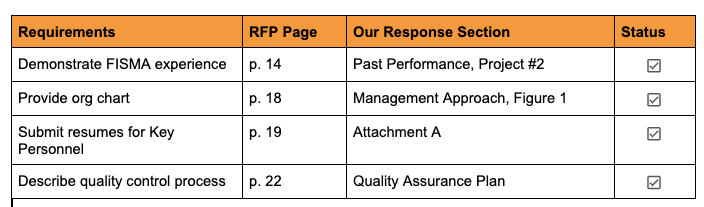
Why this matters:
Noncompliance = automatic loss.
I’ve seen contractors with better capabilities lose because they buried a requirement on page 37 instead of calling it out clearly.
The matrix becomes my proposal outline. Every section maps back to a requirement.
Part 3: Reusable Structure (This Is Where Leverage Lives)
Goal: Stop rewriting what you’ve already written.
Time to set up: 1-2 hours (one time) Time saved per proposal: 15-20 hours
There are sections of proposals that should NEVER be reinvented:
Company Overview
Who we are
NAICS codes
Certifications
Years in business
Team size
I have 3 versions of this:
IT services focus (250 words)
Professional services focus (250 words)
Training services focus (250 words)
I copy/paste and adjust dates. That’s it.
Management Approach
How we structure teams
Communication protocols
Project kickoff process
Reporting cadence
This is standard across 90% of my bids. I adjust specifics (agency name, project title), but the framework stays the same.
Quality Control Language
Our QC process
Review cycles
Issue escalation
Performance metrics
I’ve used the same 400-word QC section on 8 different proposals. Win rate on those proposals: 15%.
Past Performance Framing
I maintain a library of 5 past performance narratives:
Project summary (100 words)
Challenge/solution/result format
Metrics included
Client contact info template
When I need past performance, I pull 2-3 relevant projects and adapt. I don’t rewrite from memory.
This alone cut my drafting time in half.
Part 4: AI-Assisted Drafting (With Boundaries)
Goal: Use AI as a tool, not a replacement for strategy.
I use Claude and ChatGPT, but very intentionally.
AI is great for:
First drafts of standard sections
Rewording for clarity (I write, then ask AI to tighten)
Structuring complex requirements into readable responses
Pulling themes from multiple past performance examples
Example prompt I use:
“I need to respond to this requirement: [paste]. Here’s our relevant experience: [paste 3 project summaries]. Act as a professional government proposal writer with 10 years of experience and draft a 200-word response that highlights our FISMA certification and includes metrics.”
AI is terrible at:
Judgment (should we even bid on this?)
Knowing what the evaluator actually cares about
Understanding agency-specific buying patterns
The system comes first. AI supports the system, it doesn’t replace thinking.
Part 5: Review Like an Operator, Not a Writer
Goal: Catch problems that lose contracts, not just typos.
I don’t “proofread.” I review for:
1. Compliance
Did we answer every requirement?
Is the compliance matrix complete?
Are all attachments included?
2. Alignment to evaluation criteria
If technical is 60%, did we spend 60% of our page count there?
Are we answering what they’re actually scoring?
3. Consistency
Do our labor rates match across sections?
Are acronyms defined on first use?
Does our org chart match our staffing plan?
4. Clarity
Can an evaluator with 2 hours and 10 proposals understand what we’re offering?
This is where checklists matter more than talent.
I have a 17-item pre-submit checklist. I’ve never submitted a proposal without running through it.
Why This Workflow Works
Because it:
Reduces decision fatigue (you’re not reinventing structure every time)
Eliminates last-minute scrambling (compliance is locked down on Day 1)
Makes delegation possible (anyone can follow the matrix)
Creates repeatability (win or lose, you know what you did)
My results before vs. after:
Before this workflow:
Proposals submitted: 23
Wins: 0
Average time per proposal: 38-42 hours
Feeling: Exhausted, demoralized
After this workflow:
Proposals submitted: 12
Wins: 4
Win rate: 33%
Average time per proposal: 18 hours
Revenue from those 4 wins: $420K
Same person. Same capabilities. Different system.
Your Action Plan (Tonight)
Set a timer. Do this in the next 45 minutes.
Minutes 1-10: Pull Your Last 3 Proposals
Open the files
Highlight sections that were identical or near-identical across proposals
Those are your reusable blocks
Minutes 11-20: Build Your Compliance Matrix Template
Open a Google Sheet or Excel
Create columns: Requirement | RFP Page | Our Response Section | Status
Save as “Compliance_Matrix_Template_v1”
Use this on every proposal moving forward
Minutes 21-35: Start Your Reusable Content Folder
Create files for:
Company_Overview.docx
Management_Approach.docx
Quality_Control.docx
Past_Performance_Library.docx
Copy/paste from your last proposal. Edit for clarity. Save.
Minutes 36-45: Document Your Review Checklist
Write down the 10 things you always forget to check before submitting.
That’s your pre-submit checklist.
Total time: 45 minutes. Result: You’ll never start a proposal from scratch again.
What I’m Working on Next
I’ve automated parts of this workflow for myself using AI tools+ custom prompts.
Intake extraction: automated Compliance matrix generation: automated Reusable content assembly: partially automated
If it keeps working, I’ll package it as a tool.
No waitlist. No “reserve your spot” garbage.
Just building in public and sharing what works.
The Uncomfortable Truth
Most contractors fail at proposals because they confuse activity with leverage.
Writing for 40 hours feels productive.
But if you’re rewriting the same company overview for the 15th time, you’re not being productive, you’re just being repetitive.
The goal isn’t to work harder. It’s to work smarter.
Build the system once. Refine it. Then use it every time.
That’s how you scale without burning out.
Your Move
Stop starting from scratch.
Build your compliance matrix. Create your reusable sections. Assemble, don’t invent.
You’ll get 22 hours back per proposal. Use them to bid on better opportunities or take a day off.
Either way, you win.
P.S. I’ll be breaking down each part of this workflow in future posts, with checklists, templates, and real examples. This is the lab. Not the hype.